NCGA – March Primaries 2026 Preview, Part II – North Carolina House of Representatives

2026 is an election year for all 170 seats at the NCGA, and we’re taking an early look at which North Carolina Representatives will be facing primaries in March, who are in contested races in the General Election, and who are running unopposed. This is Part II of a two-part Roboro Insights Series, covering the March 2026 primaries. Click here to read Part I, where we previewed the NC Senate Primary Races.
Arm yourself with these early insights to get a head start on advocacy as you look ahead to the 2027-2028 biennium.
Current Party Count:
The NC House is currently made up of 71 Republican and 49 Democratic Members. Republicans are one seat shy of a supermajority, which they could gain if they win an additional seat in November.
All 120 seats are up for re-election in November 2026.
Key Dates:
December 19, 2025 - Filing deadline to run in a primary.
March 3, 2026 – Primary Elections.
April 21, 2026 – Start of NCGA 2026 Short Session.
May 12, 2026 – Primary Runoff Elections (only occur if first place candidate receives less than 30% of the votes cast).
November 3, 2026 - General Election.
Key Reminders:
North Carolina Representatives serve two-year terms and are not subject to term limits.
North Carolina legislators assume office on January 1 the year after their election, in this case, 2027.
Key Takeaways
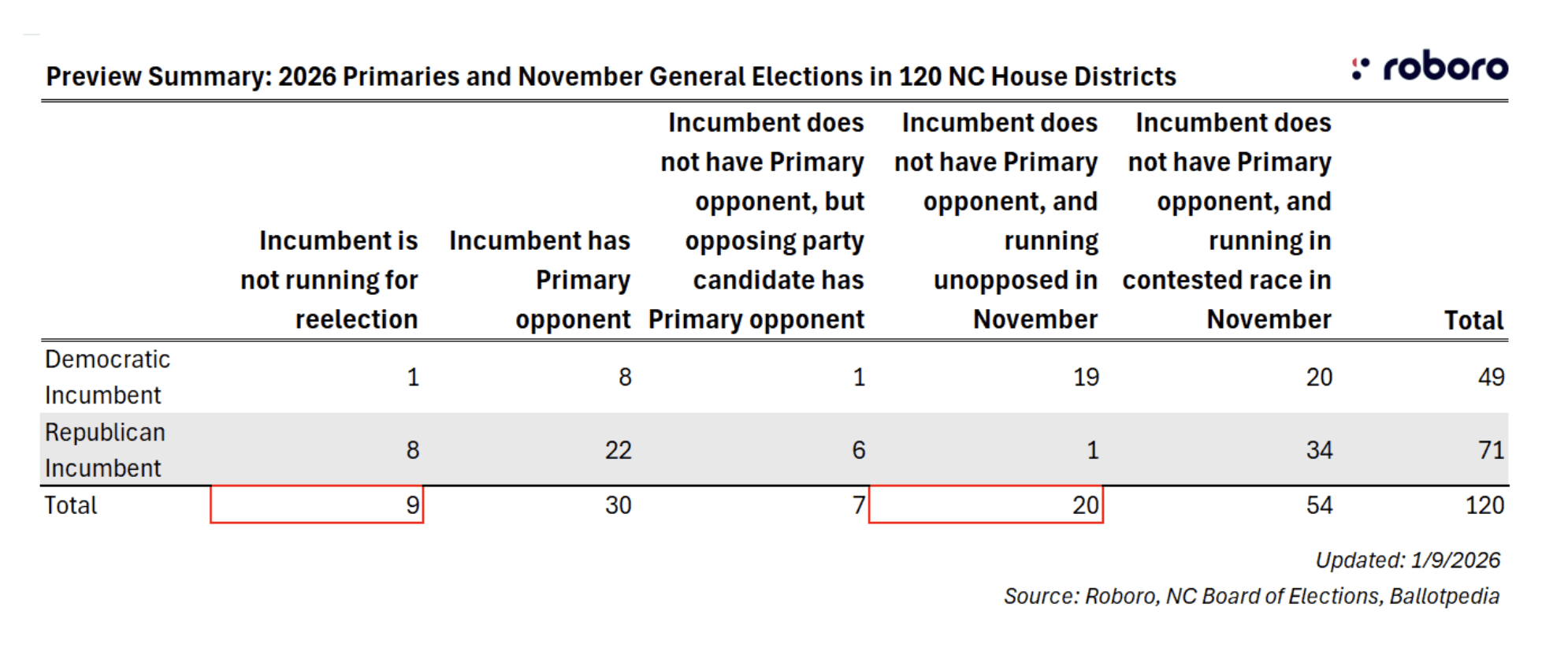
42 Districts (out of 120) in NC will hold Primary Elections for the House. Only three districts (Districts 6, 32, and 43) are simultaneously holding Democratic and Republican Primaries.
9 Members (8 Republicans and 1 Democrat) are not seeking re-election. At a minimum, 9 new House members will be elected in November to replace these seats.
22 Incumbent Republican Members have challengers in the March primary races.
8 Incumbent Democratic Members have challengers in the March primary races, including 3 Democrats that voted with Republicans on veto overrides this year.
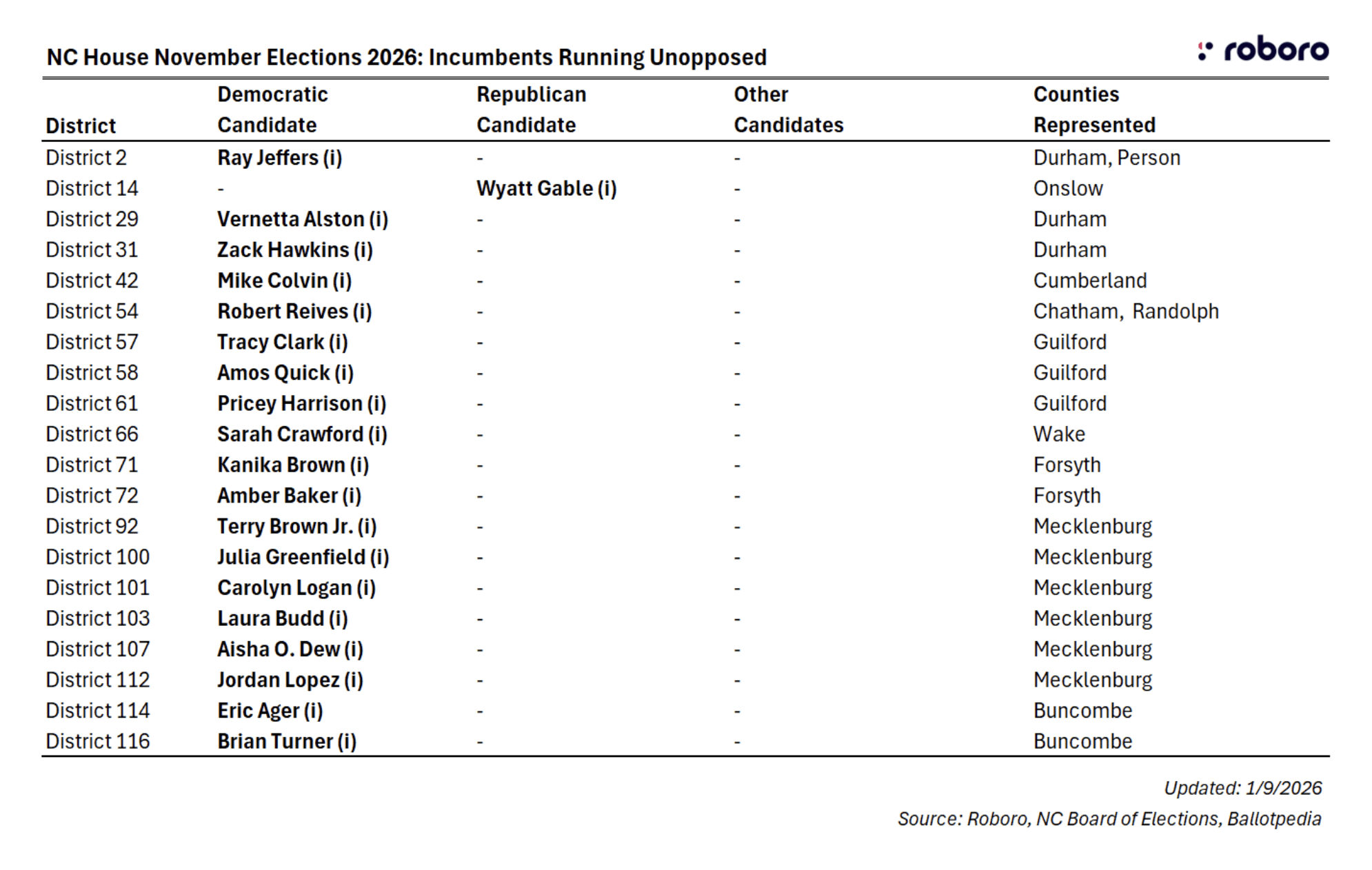
20 Incumbents (19 Democrats and 1 Republican) will be running unopposed in November. At minimum, we expect these 20 House members to return in 2027-2028.
Key Primary Races
Heading into the primaries, the North Carolina House currently has 71 Republican Members and 49 Democratic Members. With the Republican party one seat short of a veto-proof supermajority, the stakes are high for both parties.
For Republicans, the focus is gaining an additional seat to secure supermajority control.
For Democrats, the goal is flipping competitive districts to narrow the balance of power in the chamber.
With 9 Incumbents not seeking re-election, open seats will play a key role in determining the House’s party makeup for the 2027-2028 biennium.
In the News
NC teachers to run in GOP primary for state legislature. Will it have an impact? (News & Observer)
Field is set for NC 2026 elections as filing closes (Carolina Public Press)
In a Wake County NC House race, a GOP lawmaker faces an opponent who's new to the party (WUNC)
Incumbents Not Seeking Re-Election (Open Seats)
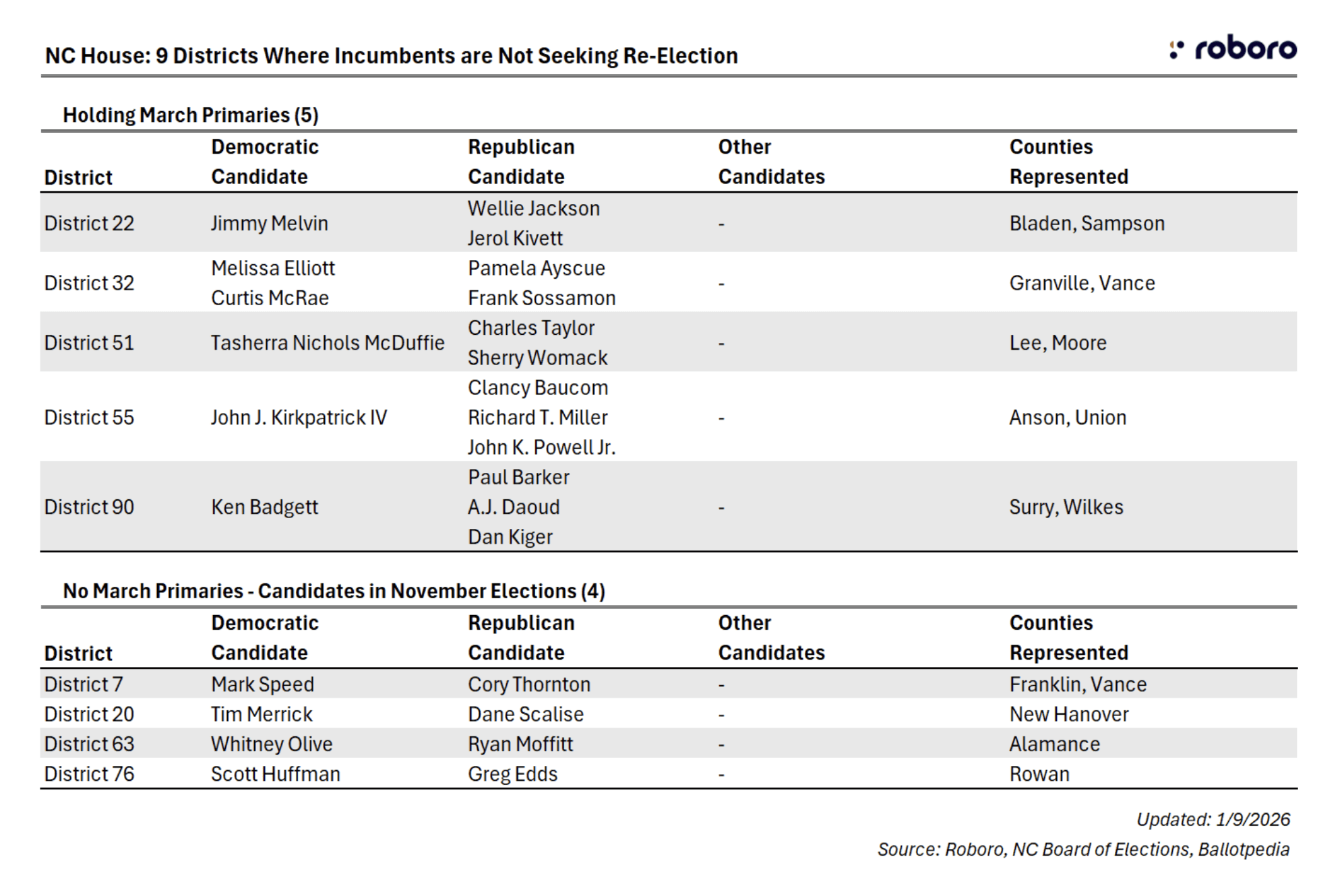
9 Incumbents are not seeking re-election for the 2027-2028 Session, creating a wave of open seats that could significantly reshape the NC House.
Currently, 8 of these seats are held by Republican Members and 1 by a Democrat, several of whom are longtime legislators with key committee chairmanships. Below is a list of the 9 incumbents who are not seeing re-election:
Republican Incumbents not seeking re-election (8)
Rep. Matthew Winslow (R-District 7; Franklin, Vance)
Terms in Office: 3
Committee Chairmanships: Appropriations, Capital and Information Technology; Energy and Public Utilities
Rep. Ted Davis, Jr. (R-District 20; New Hanover)
Terms in Office: 7.5
Committee Chairmanships: Appropriations, Justice and Public Safety; Judiciary 1
Rep. William D. Brisson (R-District 22; Bladen, Sampson)
Terms in Office: 10
Committee Chairmanships: Appropriations
Rep. John Sauls (R-District 51; Lee, Moore)
Terms in Office: 7
Committee Chairmanships: Commerce and Economic Development
Rep. Mark Brody (R-District 55; Anson, Union)
Terms in Office: 7
Committee Chairmanships: Housing and Development
Rep. Stephen M. Ross (R-District 63; Alamance)
Terms in Office: 6
Committee Chairmanships: Commerce and Economic Development; Finance
Rep. Harry Warren (R-District 76; Rowan)
Terms in Office: 8
Committee Chairmanships: Ethics; House Select Committee on Oversight and Reform; Oversight
Rep. Warren is leaving the legislature to run for Clerk of Superior Court
Rep. Sarah Stevens (R-District 90; Surry, Wilkes)
Terms in Office: 9
Committee Chairmanships: Election Law; Judiciary 2
Rep. Stevens is leaving the legislature to run for NC Supreme Court
Rep. Stevens is currently a top House Sponsor for getting bills passed.
Democrat Incumbent not seeking re-election (1)
Rep. Bryan Cohn (D-District 32; Granville, Vance)
Terms in Office: 1
Of these 9 open districts:
5 Districts will hold primary races - District 22 (Bladen, Sampson), District 32 (Granville, Vance), District 51 (Lee, Moore), District 55 (Anson, Union), and District 90 (Surrey, Wilkes)
4 Districts will not have primary races - Placing the candidates in the table below directly on the November ballot: District 7 (Franklin, Vance), District 20 (New Hanover), District 63 (Alamance), and District 76 (Rowan).
Notably, District 32 (Granville, Vance) is one of only three districts holding both a Democratic and Republican primary in March. Additionally, Frank Sossamon (R) is a former House Member, who represented this district from 2023 to 2025.
Incumbents with Primary Challengers
Republican Incumbents with Primary Challengers (22)
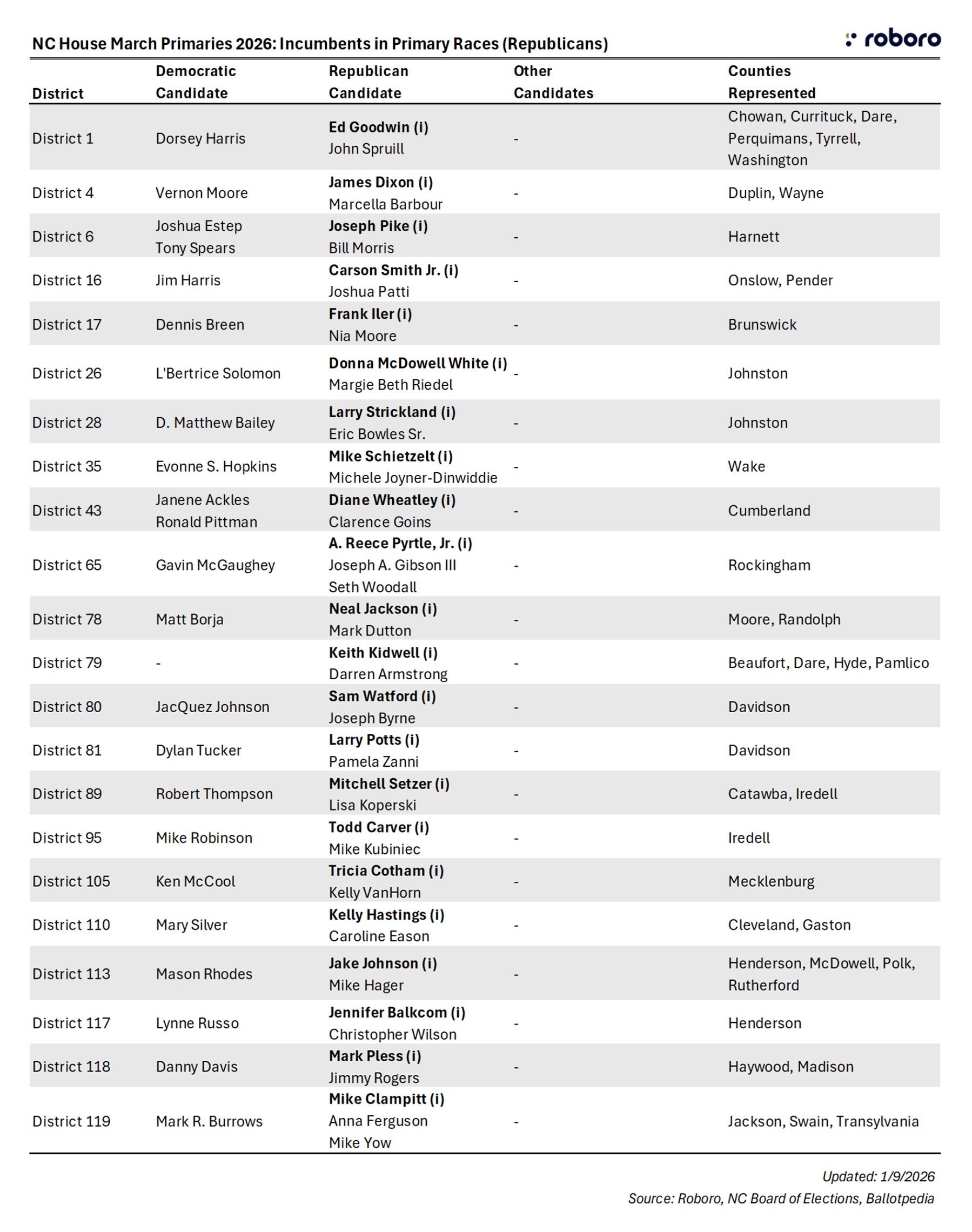
22 Incumbent Republican Members are in primary races.
District 6 (Harnett) and District 43 (Cumberland) are two of three districts holding a Democratic and Republican primary in March. Rep. Pike (R-District 6) and Rep. Wheatley (R-District 43) are the incumbents.
Notably, in District 79 (Beaufort, Dare, Hyde, Pamlico), there are no Democratic candidates. The winner of the Republican Primary, Rep. Kidwell (R) vs. Darren Armstrong (R), will be running unopposed come November.
Democratic Incumbents with Primary Challengers (8)
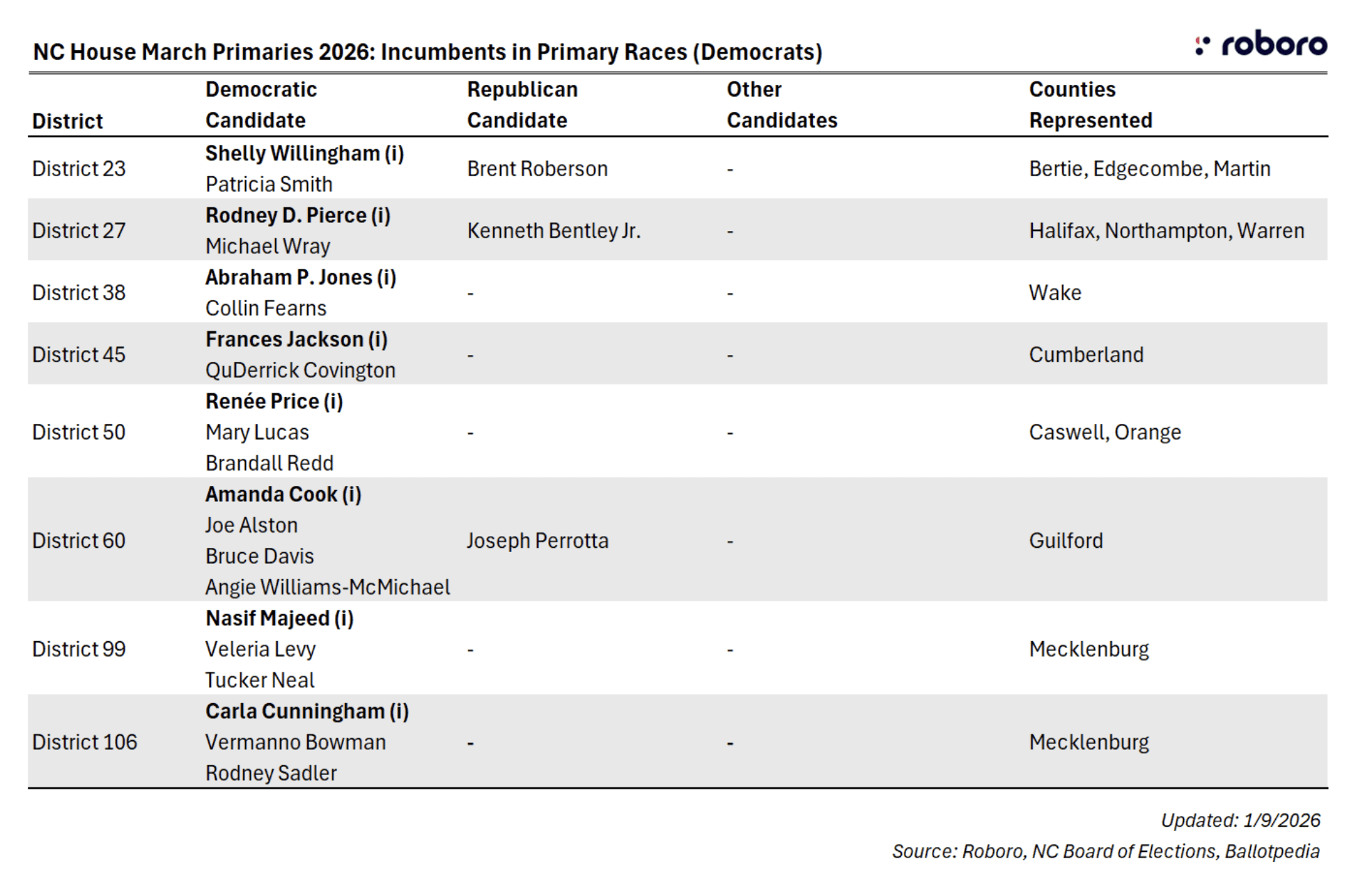
8 Incumbent Democratic Members are in primary races.
Notably, in District 27 (Halifax, Northampton, Warren), incumbent Rep. Rodney Pierce (D) is facing Michael Wray (D), who formerly held this seat, from 2005 until 2025.
Additionally, of the 4 Democrats who joined Republicans on veto overrides this year, 3 face Primary challengers (Representatives Willingham, Cunningham, and Majeed).
In District 106, where Rep. Cunningham (D) is facing Vermanno Bowman and Rodney Sadler in the Primary, Governor Stein has endorsed Rodney Sadler (WRAL).
In District 60, Rep. Amanda Cook (D) is facing 3 primary challengers. She was appointed in November to replace former Rep. Cecil Brockman, who was the fourth Democrat to vote with Republicans on veto overrides this year.
In 5 of these 8 Districts, there are no Republicans running, so the winner of these Primaries will be running unopposed come November:
District 38 (Wake) – Rep. Abe Jones vs. Collin Fearns
District 45 (Cumberland) – Rep. Frances Jackson vs. QuDerrick Covington
District 50 (Caswell, Orange) – Rep. Price vs. Mary Lucas vs. Brandall Redd
District 99 (Mecklenburg) – Rep. Majeed vs. Veleria Levy vs. Tucker Neal
District 106 (Mecklenburg) – Rep. Cunningham vs. Vermanno Bowman vs. Rodney Sadler
Incumbents Facing Winner of a Primary Race
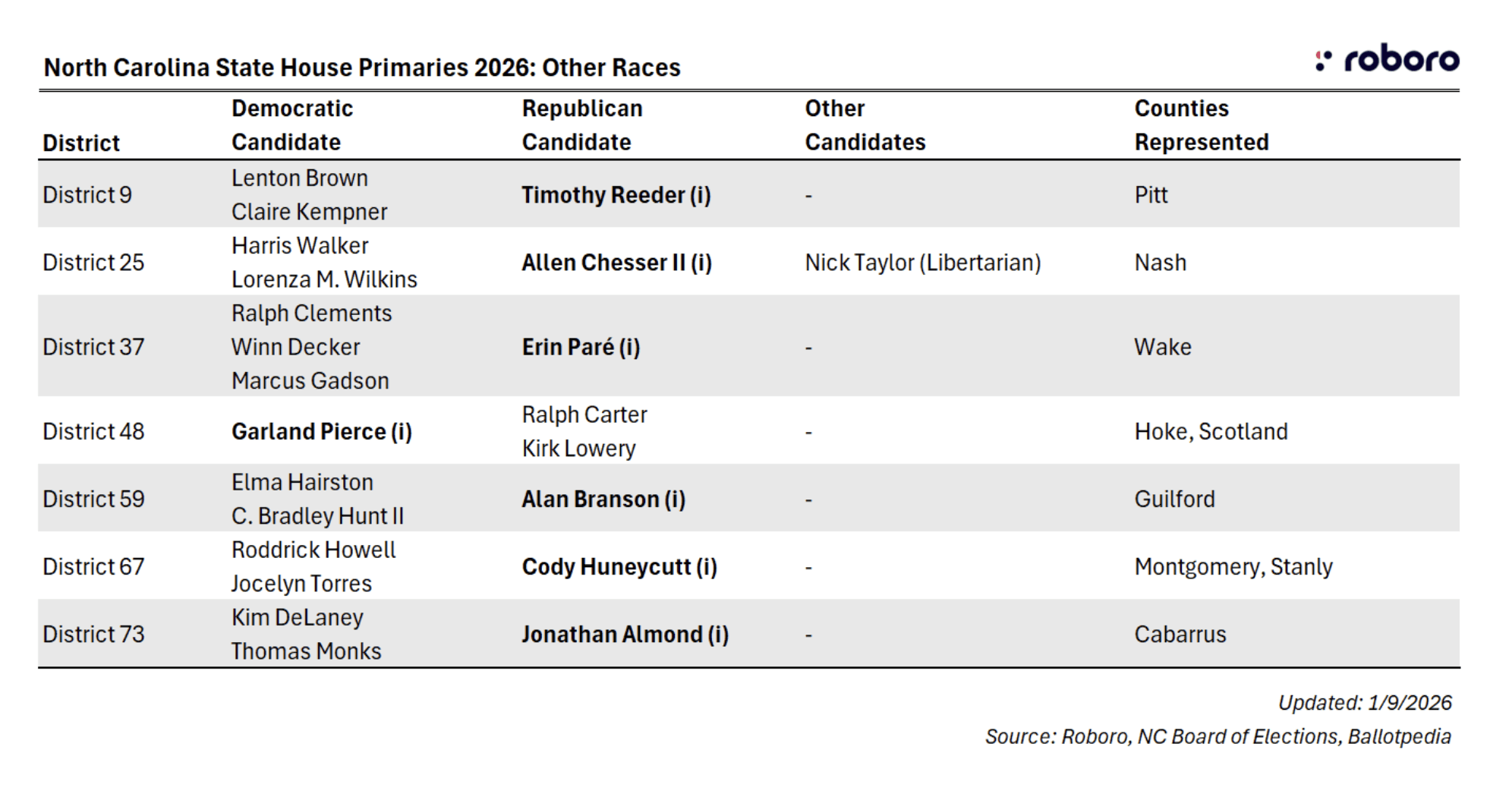
In 7 Districts, the incumbent Representative will be facing the winner of the following primaries come November. They are:
6 Republican Representatives: Reeder (R-District 9), Chesser (R-District 25), Paré (R-District 37), Branson (R-District 59), Huneycutt (R-District 67), and Almond (R-District 73).
1 Democratic Representative: Garland Pierce (D-District 48).
Incumbents Running Unopposed in November
20 Incumbents are running unopposed in November – 19 Democrats and 1 Republican.
That means we expect, at a minimum, these 20 House members will return in 2027-2028 – as they do not have primary challengers or opponents from the other party.
Incumbents with No Primary, but Contested General Election
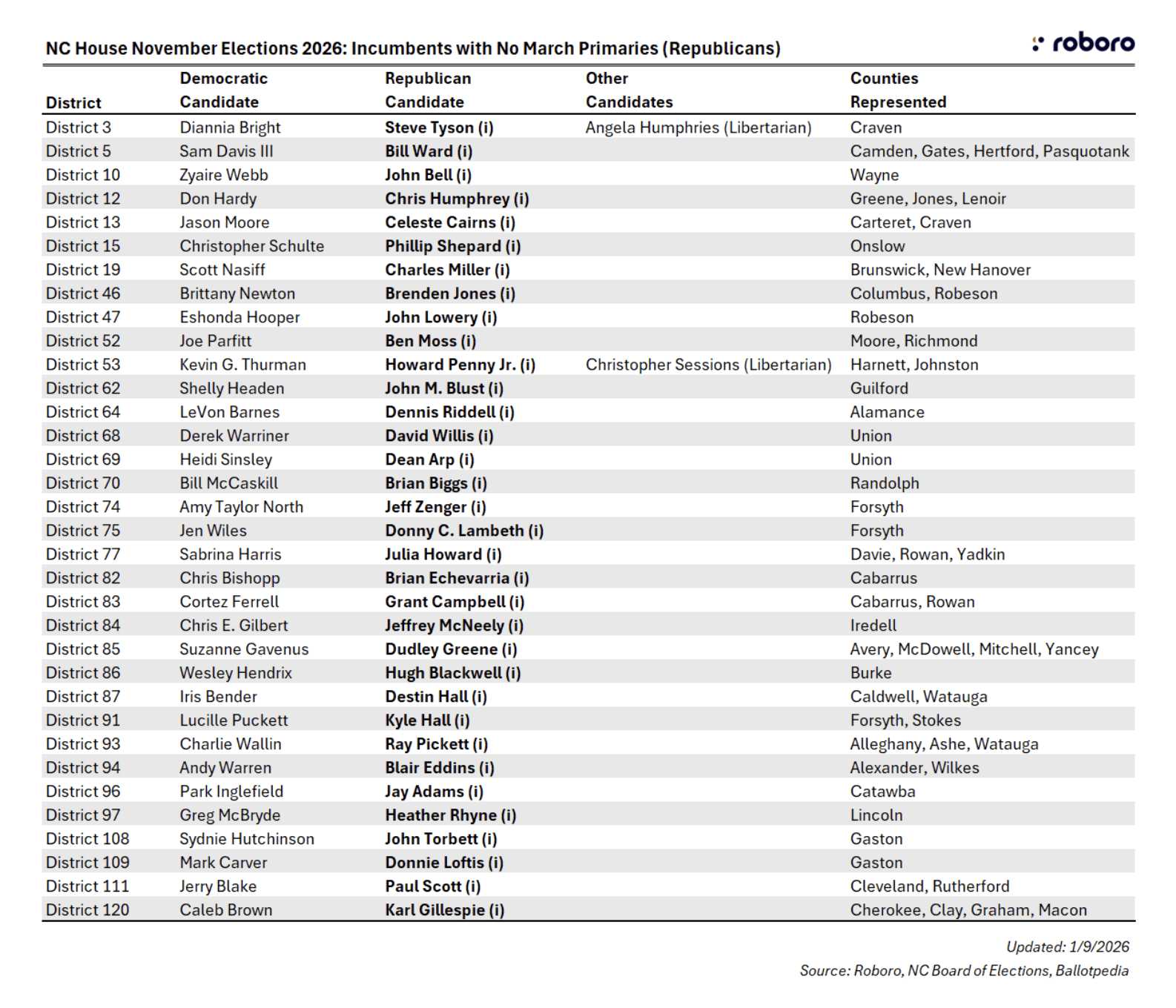
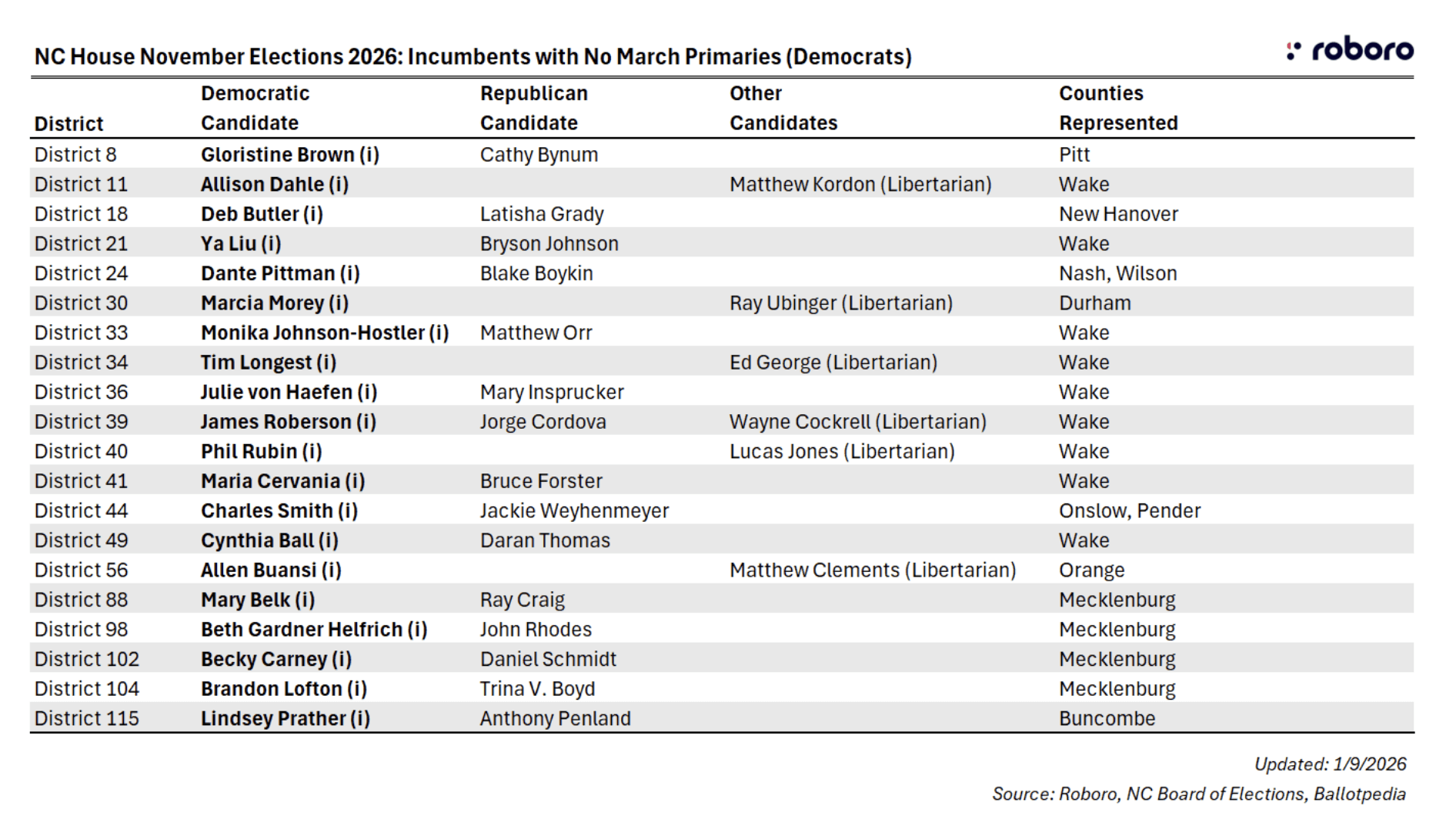
Below are the remaining 54 Districts that are not holding March Primaries, but will have an incumbent running in a contested General Election in November:
Republican Incumbents – No March Primary and running in November Race (34)
Democratic Incumbents – No March Primary and running in November Race (20)
Summary
With all 120 seats of the North Carolina House of Representatives on the ballot in November, the results of the March Primaries foreshadow where turnover is possible, which incumbents face challengers, and who is positioned to return for the 2027-2028 NCGA Session.
As a reminder, the key takeaways are:
42 Districts (out of 120) in NC will hold Primary Elections for the House. Only three districts (Districts 6, 32, and 43) are simultaneously holding Democratic and Republican Primaries.
9 Members (8 Republicans and 1 Democrat) are not seeking re-election. At a minimum, 9 new House members will be elected in November to replace these seats.
22 Incumbent Republican Members have challengers in the March primary races.
8 Incumbent Democratic Members have challengers in the March primary races, including 3 Democrats that voted on veto overrides with Republicans this year.
20 Incumbents (19 Democrats and 1 Republican) will be running unopposed in November. At minimum, we expect these 20 House members to return in 2027-2028.
Want More Insights?
Get powerful Member Insights at your fingertips – Schedule a demo today.
Got a data question you’d like the Roboro Team to dig into? Email us at hello@roboro.ai.
Want to stay on top of NCGA trends and bill movement? Sign up for our Newsletter »
