NCGA 2026 Short Session by the Numbers
2026-07-17
By Mike Phelps
On April 21, 2026, the North Carolina General Assembly started their Short Session (year two of the 2025-2026 biennium) and the NCGA was very active until adjourning on July 2.
On July 2, 2026, lawmakers in both chambers passed SB 257 (2026 Appropriations Act.), a long-awaited state budget for North Carolina, as well as HB 56 (2026 Budget Technical Corrections.). Also on July 2, lawmakers passed HJR 1244 (Adjournment Resolution.), adjourning the legislature until they reconvene on July 27, 2026.
Those July 2 votes – resulting in a passed state budget and a return date – effectively concluded the first part of this year's legislative session. Our team ran the analysis on everything that’s happened so far.
Here’s the 2026 NCGA Short Session, by the numbers.
By the Numbers
41 Legislative days
623 bills had at least one new action in the 2026 Short Session (83 filed in 2025 and 540 filed in 2026)
540 new bills were filed in the 2026 Short Session
54 bills have become Session Law (40 Public bills and 14 Local bills)
4 vetoed bills were overridden and enacted into law this Short Session
1 bill was vetoed by Governor Stein (HB 437: Drug-Free Zones/Unauthorized Public Camping)
4 total bills remain vetoed – these can still be overridden by the NCGA
13 bills remain in conference committee
5 resolutions have been adopted, including HJR 1244 (Adjournment Resolution.)
0 bills are currently pending Governor Stein’s signature
4 Senators were the first primary sponsor on 12 out of the 22 Senate Bills that became law (55%)
25 Representatives were the first primary sponsor of the 32 House bills that became law – and no single member was the first primary sponsor of more than 2 bills that passed. Among the members with 2 first-primary bills that became law, Rep. Iler (R) had the highest passage rate with 2 out of 5 passing (40%).
Bills Filed this Short Session
540 bills have been filed since Short Session began on April 21, 2026:
House: 228 Bills
Senate: 312 Bills
The largest number of bills filed was on April 30, 2026 – the bill filing deadline for public bills. On that day alone, 198 bills were filed – 125 Senate Bills and 73 House Bills – which accounted for 37% of all bills filed this Short Session so far.
By the May 5 filing deadline for local bills, 513 bills had been filed (95% of all bills filed this Short Session). Only 27 bills have been filed after the May 5 deadline. Per SJR 776 (Adjournment Resolution Changes), certain categories – such as bills related to election law or redistricting – can be filed at any time, which accounts for the handful of bills filed through June and July.
In total, 2,334 bills have been filed so far in the 2025-2026 biennium – 76.9% filed in 2025 and 23.1% filed in 2026.
Bills that Have Become Law
So far this Short Session, 54 bills have become law: 32 House Bills and 22 Senate Bills. This excludes the 5 Joint Resolutions that have been adopted. These measures range from high-profile statewide legislation, including the state budget, to targeted local bills.
In total, 151 bills have become law so far in the 2025-2026 biennium (this excludes the 16 Joint Resolutions that have been adopted). 60.9% passed in 2025 and 39.1% passed in 2026.
View a list of all session law in Roboro here. (Source: NCLeg.gov)
Members who Sponsored Bills that Became Law
At the conclusion of the Long Session last year, we analyzed legislation that passed and identified which Primary Sponsors had the highest rates of their bills being passed into law.
We ran the same analysis for the 2026 Short Session: looking across all bills filed during the 2025-2026 biennium, of the 54 bills that became law this Short Session, who first-primary sponsored the most bills – and who had the highest passage rate?
The tables below show the top sponsors in each chamber, excluding joint resolutions. Of the 54 Session Laws, 32 originated in the House and 22 in the Senate.
Note: several of the laws shown below were “gutted-and-replaced” – the bill was rewritten via committee substitute into entirely different legislation. Those bills are marked with an asterisk (*), with details in the notes below the tables.
Senate Members
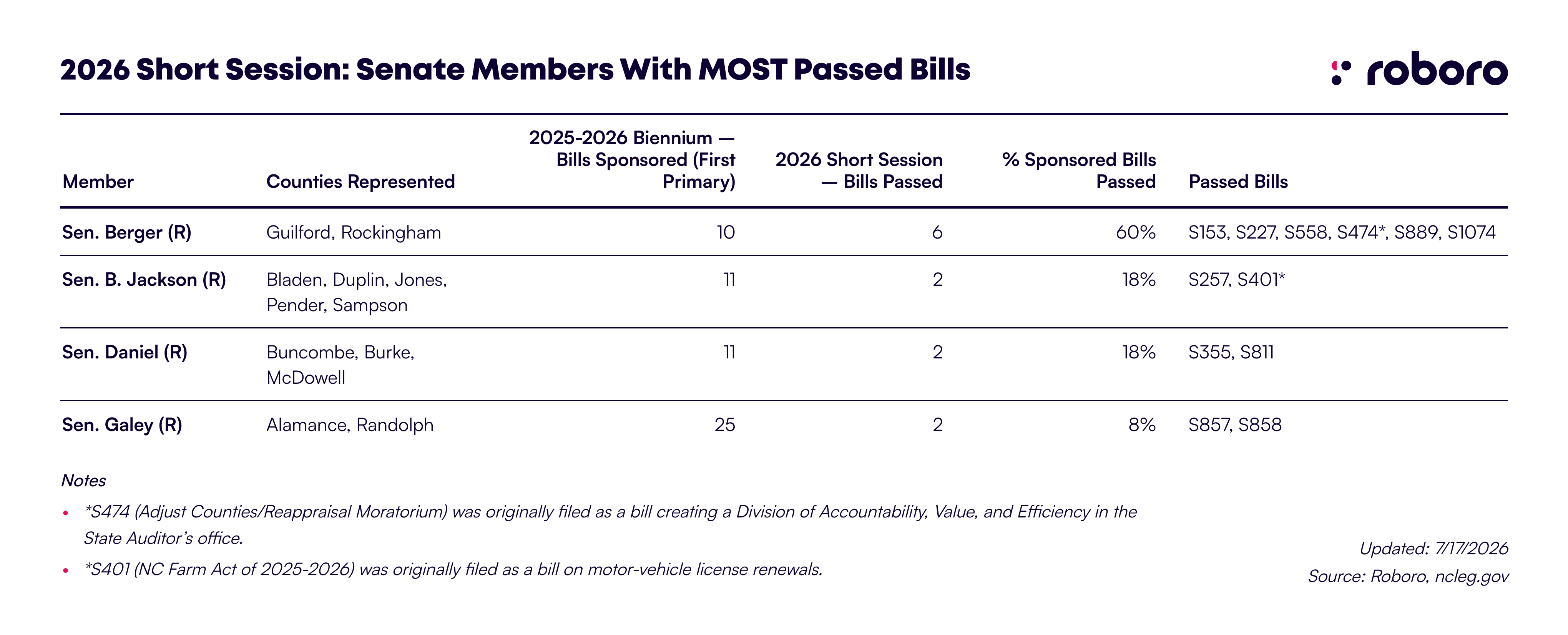
In the Senate, a small group drove the most Session Laws: just four senators were the first primary sponsor on 12 out of the 22 Senate Bills that became law (55%).
Senate Leader Phil Berger (R) stands out by a wide margin: he was the first primary sponsor of 10 bills, 6 of which became law (a 60% passage rate, the highest in the chamber).
It’s a notable datapoint for the longtime leader. After losing his March primary to Rockingham County Sheriff Sam Page, Berger will end his 15-year run as President Pro Tempore, and the Republican caucus will choose new Senate leadership ahead of the 2027-2028 biennium. It’s worth watching how that transition reshapes both the Senate agenda and member passage rates in the upcoming legislative session.
House Members
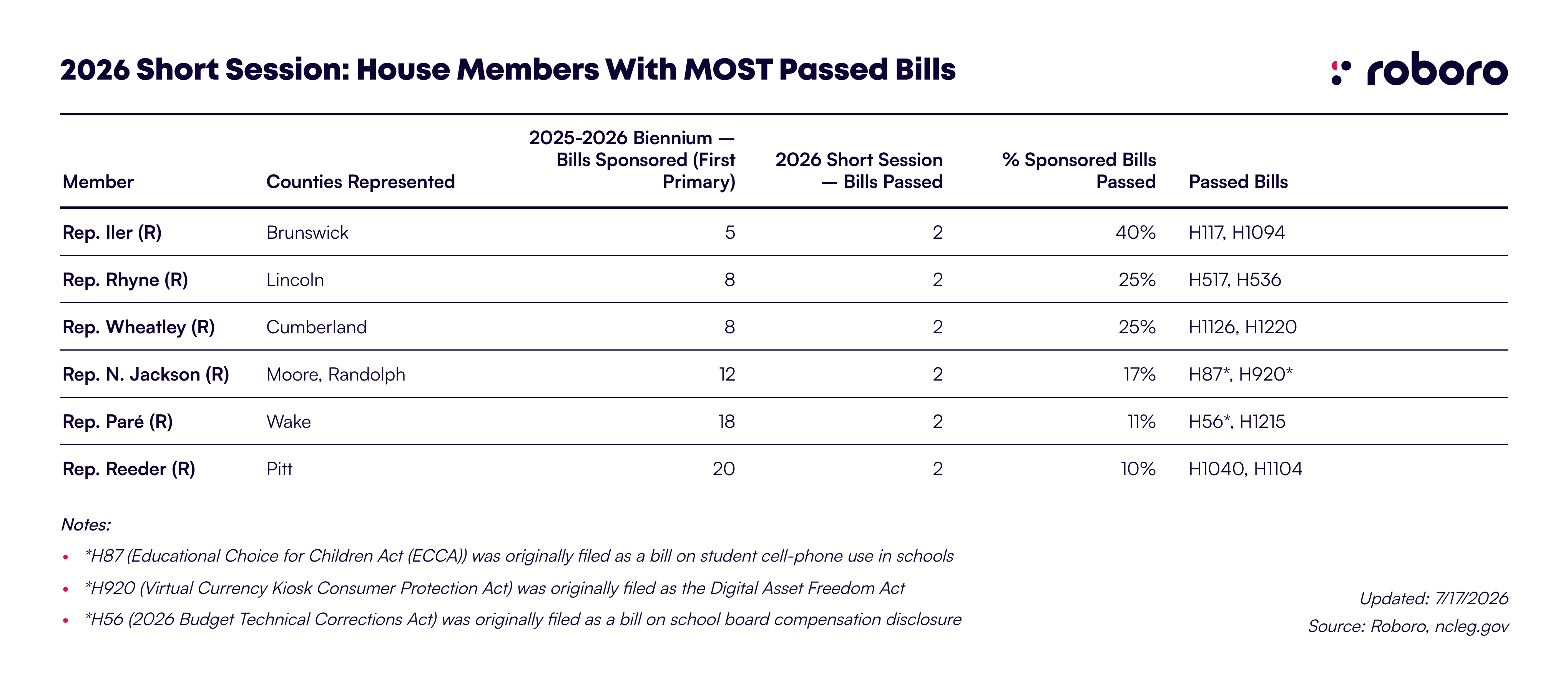
Of the 32 House bills that became law, 25 different representatives served as the first primary sponsor – and no single member was the first primary sponsor of more than 2 bills that passed.
- Among the members with 2 first-primary bills that became law, Rep. Iler (R) had the highest passage rate: of the 5 bills he first primary sponsored, 2 became law (a 40% passage rate, the highest in the group).
Bills that Have Been Vetoed
Gov. Stein’s vetoes – and the NCGA’s efforts to override them – have been a defining part of the 2025-2026 biennium. Going into the Short Session, 7 bills were still vetoed by Gov. Stein. Four of these bills had been overridden by the Senate and were waiting on action from the House (SB 50, SB 153, SB 227, and SB 558), while the other three bills had no override votes taken yet (HB 87, HB 96, HB 171).
During the Short Session, 4 of these bills had their vetoes overridden, and have become law:
HB 87 (Educational Choice for Children Act (ECCA).)
- House Override 5/20/26: 73 Aye / 46 No
- Senate Override 6/3/26: 30 Aye / 19 No
SB 153 (North Carolina Border Protection Act.)
- Senate Override 7/29/25: 30 Aye / 19 No
- House Override 6/24/26: 71 Aye / 47 No
SB 227 (Eliminating “DEI” in Public Education.)
- Senate Override 7/29/25: 30 Aye / 19 No
- House Override 6/24/26: 71 Aye / 47 No
SB 558 (Eliminating “DEI” in Public Higher Ed.)
- Senate Override 7/29/25: 30 Aye / 19 No
- House Override 6/24/26: 71 Aye / 47 No
Republicans hold a veto-proof majority in the Senate (30 Rs to 20 Ds) and are only one member shy of a veto-proof majority in the House (71 Rs, 47 Ds, 2 Unaffiliated). In the House, overrides can hinge on a handful of non-Republican absences or crossover votes.
Last year, we analyzed historical voting records to identify the Democrats most likely to help override a veto – and the trends held up here.
Two Mecklenburg members who left the Democratic Party to become Unaffiliated (Rep. Cunningham and Rep. Majeed) were the difference on the veto override for HB 87 (Educational Choice for Children Act.): their two “aye” votes pushed the override to 73, past the 71 Republicans alone.
On the three June 24 overrides for SB 153, SB 227, and SB 558, the 71 Republicans carried it on their own – Rep. Cunningham was an excused absence, Rep. Majeed voted with the Democrats, and Democrat Rep. Willingham (Bertie, Edgecombe, Martin) was recorded as not voting on all three (and was an excused absence for HB 87).
So far, Gov. Stein has issued one new veto during the Short Session – HB 437 (Drug-Free Zones/Unauthorized Public Camping.), which he vetoed on July 8, 2026.
The 4 bills below are still vetoed, and could be overridden when legislators reconvene:
HB 437 (Drug-Free Zones/Unauthorized Public Camping.) - Vetoed 7/8/26
- Governor’s Veto of HB 437
- No override votes taken
HB 96 (Expedited Removal of Unauthorized Persons.) - Vetoed 7/9/25
- Governor’s Veto of HB 96
- No override votes taken
HB 171 (Equality in State Agencies/Prohibition on DEI.) - Vetoed 7/3/25
- Governor’s Veto of HB 171
- House Override 6/24/26: 71 Aye / 47 No
SB 50 (Freedom to Carry NC.) – Vetoed 6/20/25
- Governor’s Veto of SB 50
- Senate Override 7/29/25: 30 Aye / 19 No
Bills Still in Conference
There are 13 bills that remain in conference – lawmakers could act on these when they return. These bills could also be used as a vehicle for a different purpose, such as a second budget technical corrections bill, via a Conference Committee Substitute (CCS) that fully replaces the contents of the bill.
SB 445 (Regulatory Reform Act of 2026.) - Conferees Changed 7/2/26
SB 528 (Health and Human Services Revisions.) - Conf Com Appointed 7/2/26
HB 328 (Regulate Hemp-Derived Consumables.) - Conf Report Adopted 7/2/26
HB 268 (Additional Capital Appropriations.) - Conf Com Appointed 7/1/26
HB 308 (2026 Criminal Law Changes.) - Conf Com Appointed 7/1/26
HB 377 (2026 Court Changes.) - Conf Com Appointed 7/1/26
HB 562 (Healthcare Investment Act.) - Conf Com Appointed 7/1/26
HB 356 (Various Civil and Insurance Law Changes.) - Conf Com Appointed 6/30/26
HB 198 (ABC Omnibus of 2026.) - Conf Com Appointed 6/30/26
HB 301 (Social Media & AI Safety.) - Conf Com Appointed 6/24/26
HB 936 (Robocall Solicitation Modifications.) - Conf Com Appointed 6/24/26
HB 434 (Lower Healthcare Costs.) - Conferees Changed 4/6/26
SB 423 (Title Fraud Prevention.) - Conf Com Appointed 6/23/25
What Comes Next
The NCGA has adjourned and is scheduled to reconvene on July 27, 2026, at noon, per the latest adjournment resolution. When lawmakers return, here’s what to watch out for:
Conference reports for the 13 bills still in conference (including another budget technical corrections bill)
Override attempts on any of the bills vetoed by Gov. Stein
Any matters that may be considered as outlined in HJR 1244 (Adjournment Resolution.)
Want More Insights?
Get powerful Member Insights at your fingertips – Schedule a demo today.
Got a data question you’d like the Roboro Team to dig into? Email us at hello@roboro.ai.
Want to stay on top of NCGA trends and bill movement? Sign up for our Newsletter >>
Roboro AI provides legislative intelligence for advocacy professionals. All information is current as of July 17, 2026.